




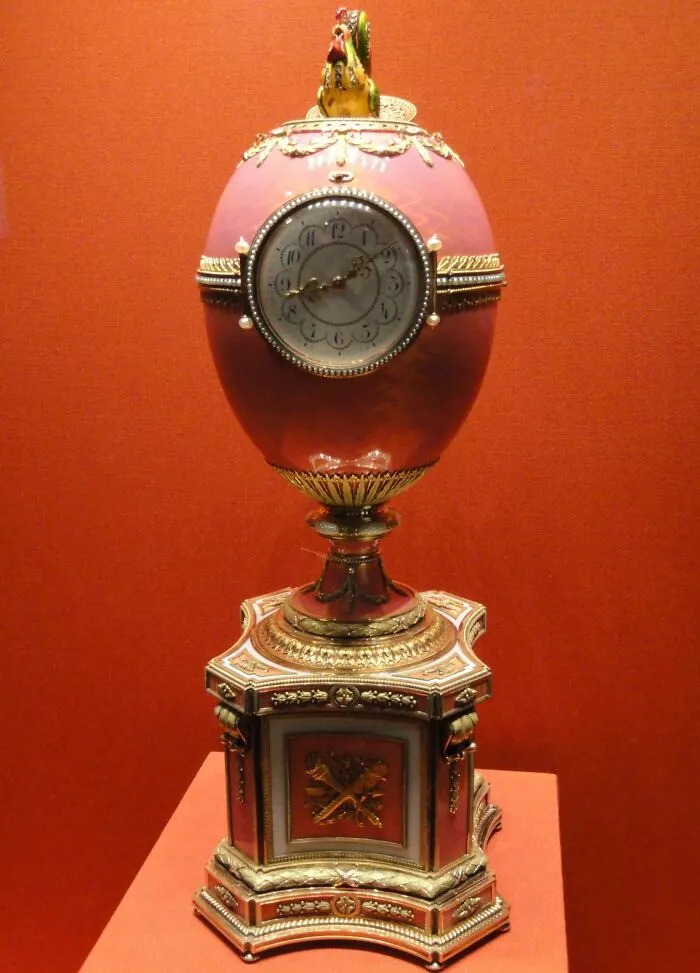
Created in 1902 by the House of Fabergé for the Rothschild banking dynasty, this is a masterwork of miniature engineering: a deep red enamel egg with a clock face set into its body, mounted on a gilded hexagonal pedestal, topped by a jeweled cockerel automaton that rises on the hour to crow and flap its wings. More than a thousand individual components are concealed inside an object you could hold in two hands.
Unlike the famous Imperial Easter Eggs commissioned by Russia’s Tsars — most scattered or destroyed after the 1917 Revolution — the Rothschild Egg remained in private hands for an entire century, largely unknown to scholars. When it sold at Christie’s London in 2007 for $18.5 million, it tripled the previous world auction record for any Fabergé work. It now resides permanently at the Fabergé Museum in Baden-Baden, Germany.
Maker: Peter Carl Fabergé, St. Petersburg
Components: 1,000+ individual parts
Commissioned: 1902, for the Rothschild family
Current location: Fabergé Museum, Baden-Baden