




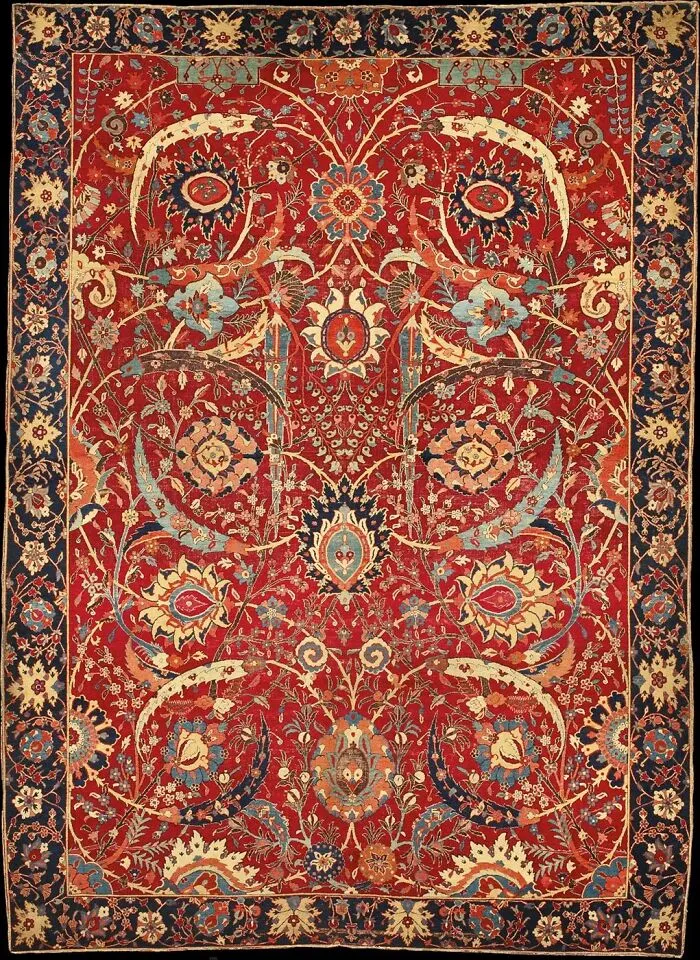
Woven somewhere in Safavid Persia during the seventeenth century, the Clark Sickle-Leaf Carpet is widely regarded as the finest surviving example of the “vase carpet” tradition — a weaving technique so technically demanding that textile historians still cannot fully reconstruct how it was done. No complete working example of the loom type required has ever been identified.
The deep crimson field, the swirling arabesque tendrils, the curving sickle-shaped leaves branching from teal and ivory palmette medallions — each square inch represents thousands of individually hand-tied knots. The palette, sourced from Silk Road dyes, has held its intensity for four centuries. When it sold at Sotheby’s New York in June 2013 for $33.8 million, it shattered all previous records for any textile sold at auction by a considerable margin. The anonymous buyer has kept it from public view since.
Origin: Safavid Persia (modern Iran)
Distinction: Most expensive textile ever sold
Era: 17th Century CE
Technique: Vase carpet, silk-wool foundation