




Humans have always been drawn to things that unsettle them. Psychologists describe part of this as morbid curiosity, an interest in things that are frightening, dangerous, or disturbing, and research suggests it is a fairly common human tendency. The appeal may lie partly in the strange combination of fear and safety: we can confront something threatening, try to understand it, and experience the emotional rush without actually being in danger. Scary experiences can also let us test our own reactions and explore the boundaries of fear.
Artists have been exploiting that fascination for centuries. Monsters, distorted bodies, hybrid creatures, impossible landscapes, and grotesque faces turn invisible fears - temptation, violence, the unknown, even our own irrationality - into something we can actually look at. That may be why the most disturbing paintings are often so difficult to ignore: they violate the rules our brains use to make sense of the world, creating just enough fear, curiosity, and uncertainty to make us look twice.
The Cool Stories About Art and TheCollector communities shared these fascinating examples of art's stranger side, from Bosch's fantastical creatures to Redon's floating eye and Blake's monstrous flea, revealing how artists have long explored our fascination with the unsettling.
#1 The Ugly Duchess By Quentin Massys, About 1513, National Gallery, London
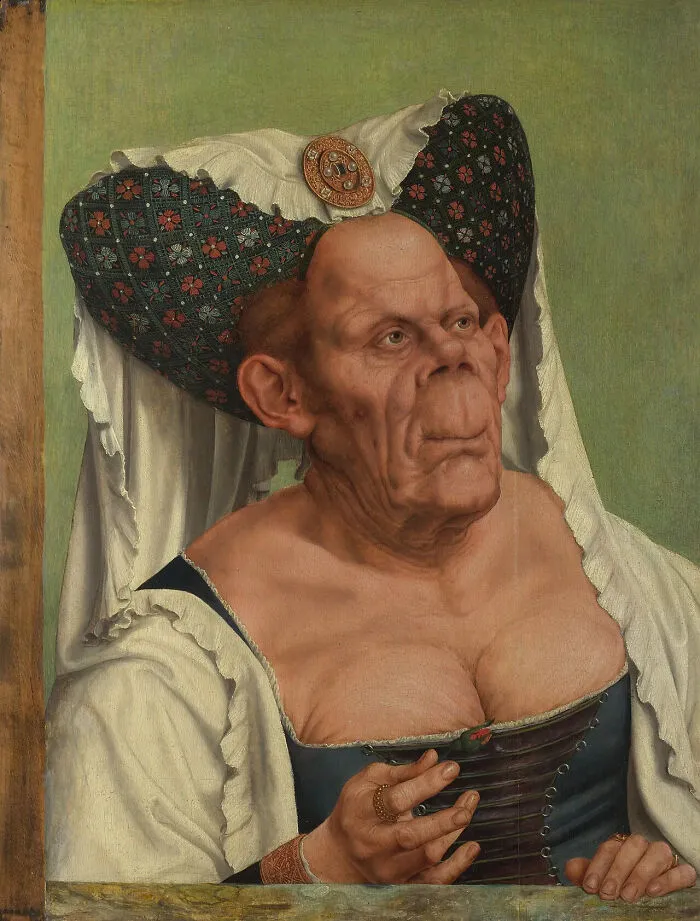
With her enormous forehead, broad nose, prominent chin, wrinkled cleavage, and elaborate horned headdress, the woman in Quentin Massys’ The Ugly Duchess seems almost deliberately designed to challenge every Renaissance ideal of female beauty. And that was largely the point. Painted around 1513, the work is actually titled An Old Woman; “The Ugly Duchess” is a nickname it acquired much later (in the 17th century, the woman was incorrectly identified as Margaret Maultasch, Countess of Tyrol, whose enemies had given her a reputation for exceptional ugliness). Her expensive clothes would already have been decades out of fashion when Massys painted her, while the low-cut, tightly laced bodice was considered particularly inappropriate for an older woman. Rather than presenting a conventional dignified portrait, Massys was creating an early piece of secular satire.
The rosebud in her hand provides an important clue to the joke. The painting originally had a companion portrait, An Old Man, and the woman appears to be offering him the flower as a symbol of love and sensual desire. He, however, raises his hand as though rejecting her advances. Together, the paintings parody the respectable Renaissance marriage portrait: she dresses and behaves as though she were a young woman being courted, while her companion refuses to play along. The National Gallery interprets the pair as a satire on vanity, desire, and the perceived foolishness of people attempting to deny their age.
Renaissance viewers were encouraged to laugh at an older woman refusing to conform to expectations about age, beauty, dress, and sexuality. But the National Gallery's 2023 exhibition devoted to the painting also invited viewers to see her as surprisingly defiant: she looks directly outward, dresses exactly as she pleases, displays her body without embarrassment, and occupies the traditionally more prestigious position reserved for men in paired portraits. More than five centuries later, the woman Massys intended as a figure of satire can therefore look unexpectedly rebellious.
The rosebud in her hand provides an important clue to the joke. The painting originally had a companion portrait, An Old Man, and the woman appears to be offering him the flower as a symbol of love and sensual desire. He, however, raises his hand as though rejecting her advances. Together, the paintings parody the respectable Renaissance marriage portrait: she dresses and behaves as though she were a young woman being courted, while her companion refuses to play along. The National Gallery interprets the pair as a satire on vanity, desire, and the perceived foolishness of people attempting to deny their age.
Renaissance viewers were encouraged to laugh at an older woman refusing to conform to expectations about age, beauty, dress, and sexuality. But the National Gallery's 2023 exhibition devoted to the painting also invited viewers to see her as surprisingly defiant: she looks directly outward, dresses exactly as she pleases, displays her body without embarrassment, and occupies the traditionally more prestigious position reserved for men in paired portraits. More than five centuries later, the woman Massys intended as a figure of satire can therefore look unexpectedly rebellious.
Report
12points
#2 The Garden Of Earthly Delights (Central Panel Detail) By Hieronymus Bosch, About 1500, Prado
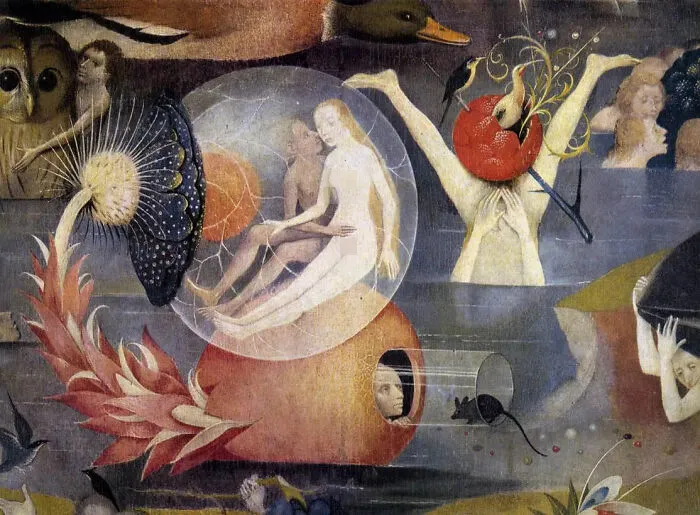
Hieronymus Bosch’s central panel of The Garden of Earthly Delights is one of the most bewildering images in Western art, and perhaps the closest the Renaissance came to creating a world that feels like a dream. Painted around 1490–1500 and now in the Museo del Prado in Madrid, the panel is the middle section of a monumental triptych whose left side depicts Paradise and whose right side descends into Hell.
The Prado interprets the central garden as a deceptive paradise devoted to lust, placing it between the innocence of Eden and the punishment of Hell. The naked men and women indulge in sensual pleasures, while oversized strawberries, cherries, berries, fish, birds, and other fruits repeatedly appear as symbols of fleeting earthly pleasure. The fragility of that pleasure is particularly striking in the small glass globe containing a couple: a contemporary Flemish idea compared happiness to glass because it can break so easily.
Report
9points
#3 Vertumnus By Giuseppe Arcimboldo, About 1590, Skokloster Castle, Sweden
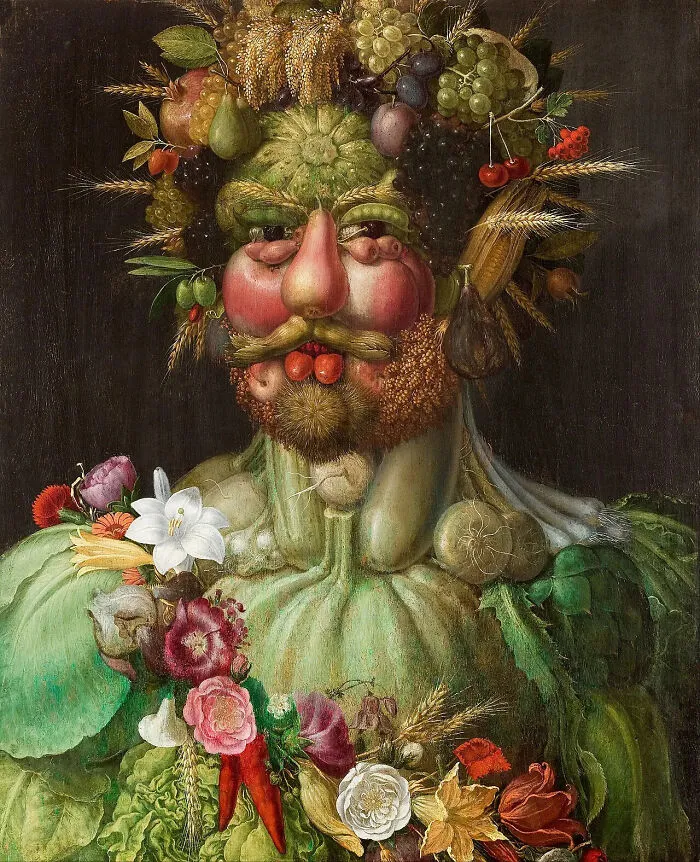
At first glance, Giuseppe Arcimboldo’s Vertumnus looks like an extravagant portrait of a Renaissance ruler. Look closer, and the emperor’s face begins to dissolve into a bizarre assortment of fruit, vegetables, flowers, and grains. A pear becomes a cheek, a peach forms the chin, cherries become lips, grapes cluster around the neck, and a garland of flowers frames the head. Painted around 1590 for Holy Roman Emperor Rudolf II, the work is far more than a visual joke: Arcimboldo transformed the emperor into Vertumnus, the Roman god of seasons, change, growth, and abundance.
The choice of Vertumnus was particularly clever because the Roman god was famous for his ability to change his appearance. According to Ovid's Metamorphoses, Vertumnus could assume different forms, making him a fitting disguise for a ruler whose portrait is itself constantly changing depending on how you look at it. From a distance, the individual fruits and vegetables merge into a recognizable human face; up close, the portrait almost disappears into its ingredients. Arcimboldo's friend Gregorio Comanini even wrote a poem to accompany the painting, praising the strange beauty of the work and describing an “ugliness” that could be more beautiful than conventional beauty.
Report
8points
#4 The Ghost Of A Flea By William Blake, About 1819, Tate, London
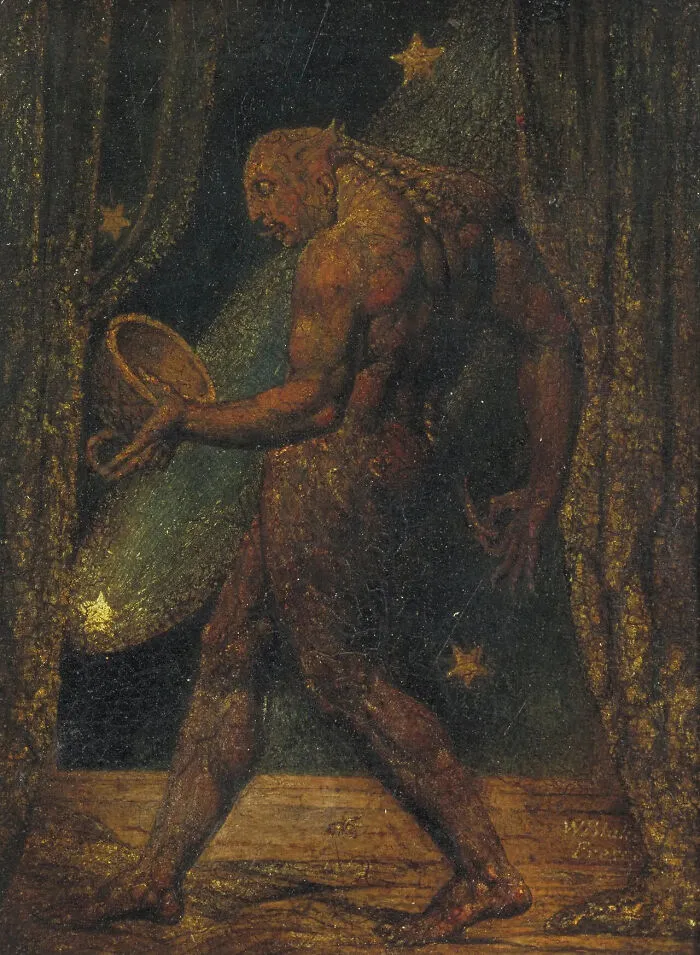
The creature strides between theatrical curtains, its reptilian skin shimmering with gold, its eyes bulging and its long tongue reaching toward a small cup of blood. It looks less like an insect than a grotesque combination of human, animal, and supernatural spirit—and Blake claimed that this was essentially what he had seen in a vision. Painted around 1819, the tiny work measures just 21.4 by 16.2 centimeters, making its enormous psychological presence all the more remarkable.
The story behind the painting is almost as strange as the creature itself. Blake's friend John Varley, an artist and astrologer fascinated by the supernatural, encouraged him to draw the “visionary heads” that Blake claimed appeared to him. During one of their late-night sessions in 1819, Blake reportedly announced that he could see the spirit of a flea and began sketching it. According to Varley's account, the flea then supposedly explained that fleas were inhabited by the souls of people who had been excessively bloodthirsty. If such souls were given bodies as large as horses, the story went, they would consume so much blood that they would devastate the population, so they had been confined to the tiny bodies of insects.
Report
6points
#5 The Sleeping Gypsy By Henri Rousseau, 1897, Museum Of Modern Art
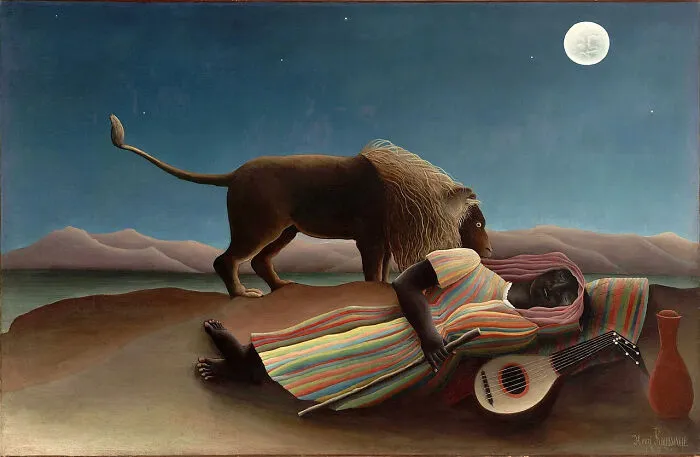
Rousseau described the scene himself as a wandering musician who, exhausted from her journey, has fallen asleep in an arid landscape. The lion catches her scent but does not attack her; instead, it simply stands over her in the moonlight. The deliberately simplified forms, crisp outlines, intensely patterned clothing, and strangely flat perspective make the desert feel less like a real geographical place than an imagined one. MoMA notes that the painting reflects Rousseau’s fascination with northern Africa and the exotic imagery circulating in 19th-century France, but emphasizes that it is far from an ethnographic study, it is better understood as another of the artist’s dreamlike inventions.
The contrast between the two figures is what gives the painting much of its tension. The woman is completely vulnerable, yet the lion behaves almost like a guardian rather than a predator. Rousseau even had the frame inscribed with the words: “The feline, though ferocious, is loathe to leap upon its prey, who, overcome by fatigue, lies in a deep sleep.” The moonlight, striped robe, curved body of the lion, and enormous empty sky all reinforce the sense that time has temporarily stopped.
Report
6points
#6 Sirens By Arnold Böcklin, 1875, Alte Nationalgalerie, Berlin, Germany
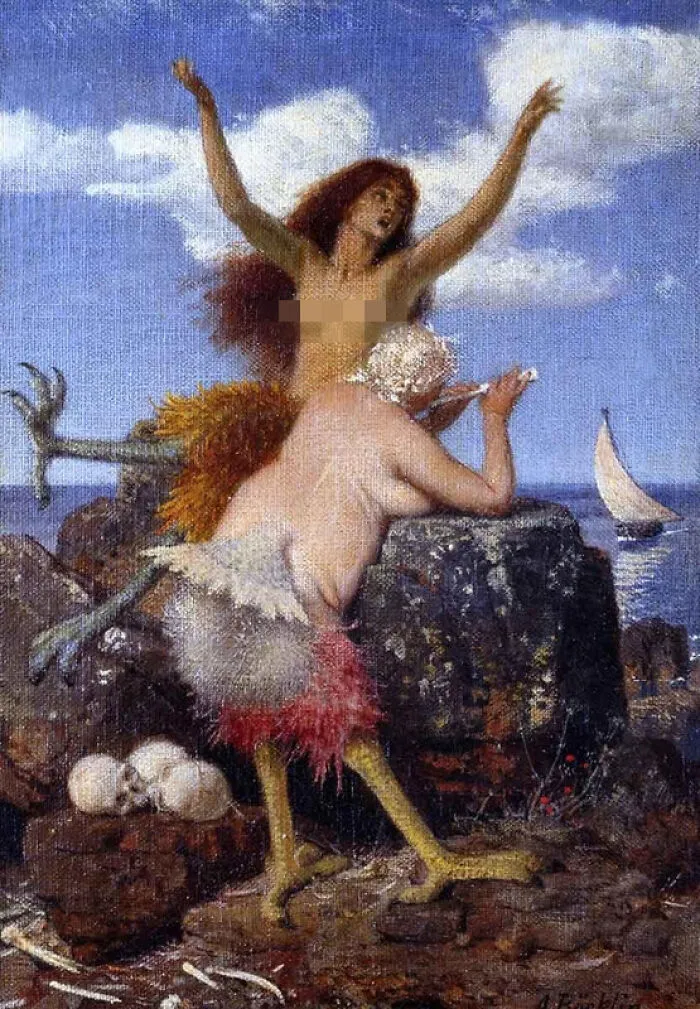
In Greek mythology, the Sirens were dangerous creatures whose enchanting songs lured sailors toward disaster. Their beauty and music were supposed to make men abandon reason and steer toward the rocks, where they would meet their fate. Böcklin turns that familiar story on its head. His sirens are not particularly beautiful or seductive; their bird feet, feathers, and exaggerated bodies make the creatures look almost ridiculous. By stripping away their conventional glamour, he creates a different kind of menace—one that is bizarre enough to make you laugh before you realize that these creatures are still supposed to be dangerous.
That mixture of the beautiful, grotesque, and absurd was characteristic of Böcklin’s Symbolist imagination. Born in Switzerland and closely associated with the German Symbolist movement, he repeatedly returned to ancient mythology, supernatural beings, and imaginary creatures, creating scenes that feel as though they belong to a half-remembered dream. His version of the Sirens is particularly effective because the painting refuses to settle into either horror or comedy: the calm sea and classical subject suggest something serious, while the strange anatomy of the creatures quietly undermines it.
Report
6points
#7 Leda And The Swan By Paul Cézanne, 1880 (Possibly Later), The Barnes Foundation, Philadelphia
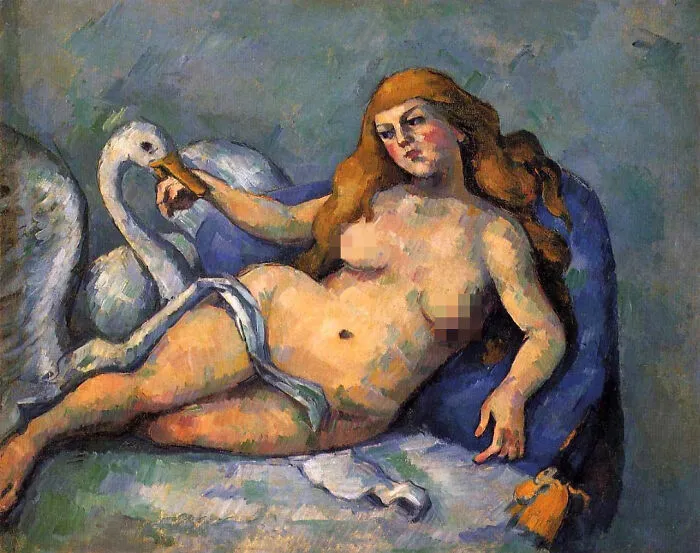
The story comes from Greek mythology and Ovid’s Metamorphoses: Zeus disguises himself as a swan and approaches Leda, the wife of King Tyndareus of Sparta. Cézanne focuses almost entirely on the encounter itself, leaving out the elaborate mythological setting normally associated with the subject. Leda's body curves dramatically across the canvas while the swan's beak reaches around her wrist, making the relationship between the two figures the central visual tension. Interestingly, preparatory drawings show that Cézanne originally gave Leda a champagne glass; the pose was apparently inspired by the image on a champagne-bottle label.
Report
6points
#8 Night By Michelangelo Di Lodovico Buonarroti Simoni, 1526–1531, Medici Chapel (New Sacristy), Basilica Of San Lorenzo, Florence, Italy
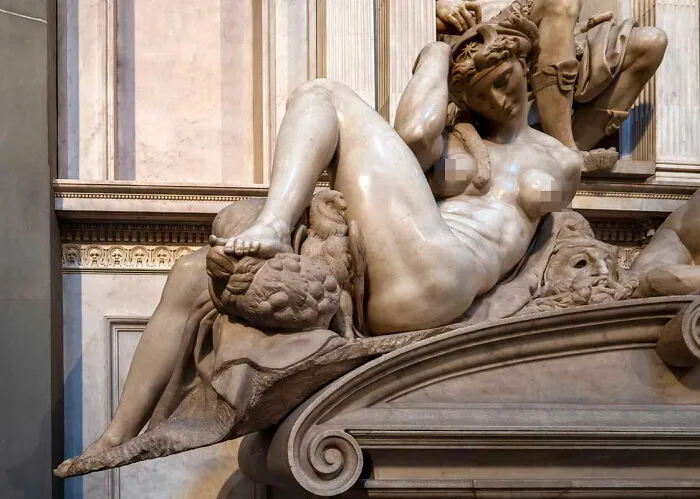
Michelangelo’s Night, carved between 1526 and 1531, is one of four monumental allegories of the times of day created for the Medici Chapel in Florence. Together, Night, Day, Dawn, and Dusk represent the relentless passage of time and the cycle of human life.
One of the strangest aspects of Night is her anatomy. Her breasts are conspicuously large compared with her waist and the rest of her elongated, muscular torso, while her limbs are stretched far beyond natural proportions. Michelangelo was not trying to create a scientifically accurate female body; he was deliberately manipulating anatomy to achieve an idealized, monumental form.
Report
6points
#9 The Overturned Bouquet By Abraham Mignon, 1660–1679, Rijksmuseum, Amsterdam
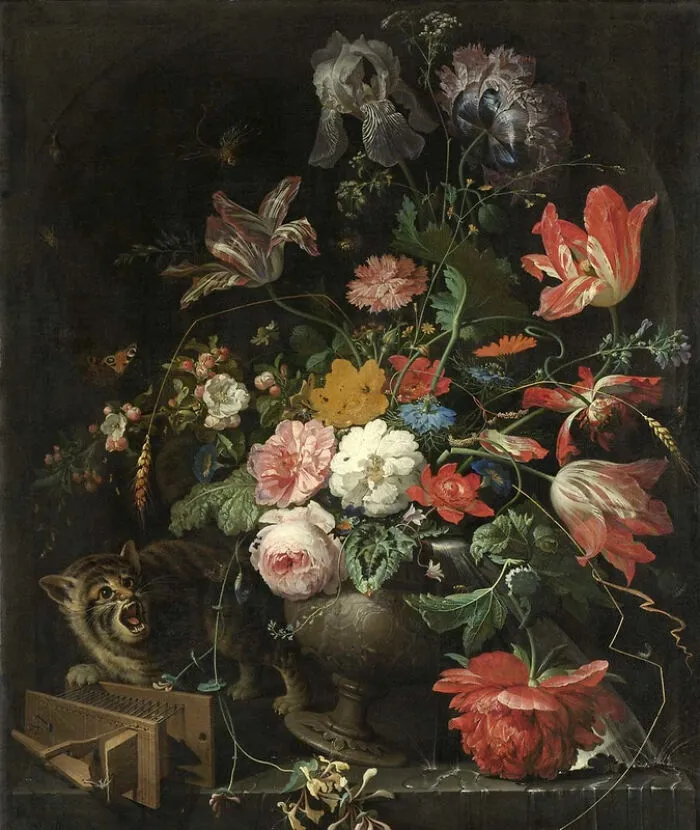
At first, it looks like an exceptionally detailed Dutch flower still life, but there is actually a tiny drama unfolding in the middle of all those petals. Abraham Mignon’s The Overturned Bouquet, painted between 1660 and 1679 and now in the Rijksmuseum in Amsterdam, combines the painstaking realism of Dutch Golden Age still life with an unexpected moment of movement and mischief.
The culprit is the cat, which appears to have upset the vase while playing with the mousetrap. Around it, Mignon packs the bouquet with an astonishing variety of flowers, including tulips, irises, poppies, carnations, and peonies. But the flowers aren't the only things worth examining. Hidden among them are ants, spiders, caterpillars, snails, flies, butterflies, and a dragonfly, turning what initially appears to be a perfectly arranged bouquet into a miniature ecosystem. The Rijksmuseum notes that Mignon's great challenge was to make different materials appear convincingly real, a quality contemporary viewers described as “semblance without being.”
Report
5points
#10 The Land Of Cockaigne By Pieter Bruegel The Elder, 1567, Alte Pinakothek, Munich
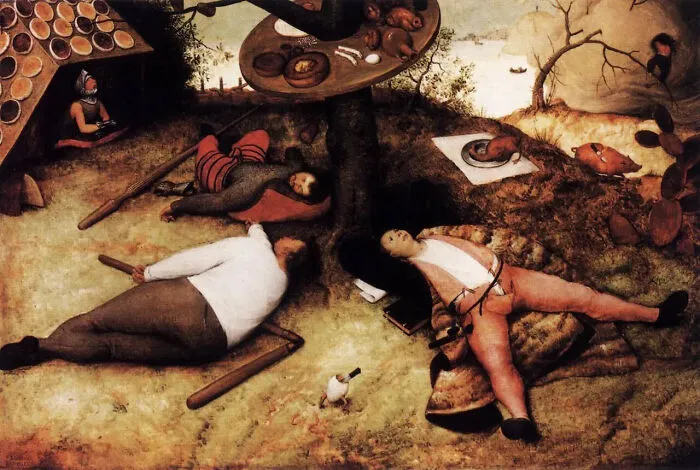
Pieter Bruegel the Elder’s The Land of Cockaigne (1567) is one of those paintings that becomes much stranger, and much darker, the longer you look at it. At first it looks like a hilarious medieval food fantasy. But Bruegel is actually making a pointed observation about laziness, gluttony, social class, and the human desire to have everything without having to work for it.
The title refers to Cockaigne, a legendary medieval land of abundance. Different European traditions imagined it slightly differently, but the basic fantasy was the same: food is everywhere, work is unnecessary, and everything you could possibly want simply comes to you.
The Dutch name is particularly revealing: Luilekkerland, roughly "Lazy Tasty Land"—a place where you can be both lazy and indulge yourself.
The Dutch name is particularly revealing: Luilekkerland, roughly "Lazy Tasty Land"—a place where you can be both lazy and indulge yourself.
Instead of painting people enjoying a wonderful paradise, Bruegel shows three men who have eaten so much that they have essentially become incapable of doing anything else. The Alte Pinakothek itself describes the painting as an exploration of idleness and gluttony across all social classes.
Report
4points
#11 The Ship Of Fools By Hieronymus Bosch, About 1505, Louvre, Paris
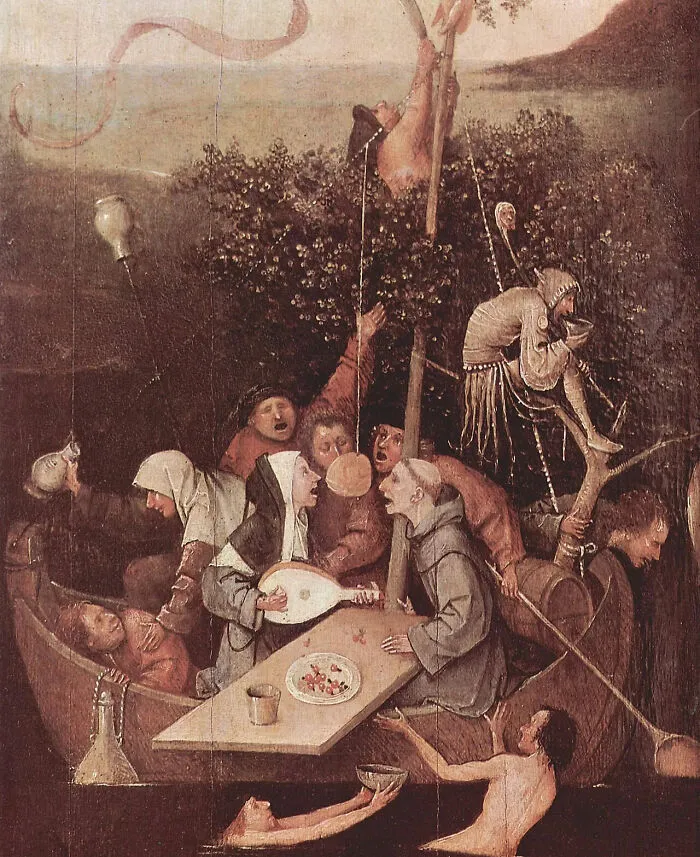
A group of revelers has climbed into a boat with no real means of steering it, leaving themselves to drift while they eat, drink, sing, and fight over food. At the center, a monk and a nun appear to join the festivities, while a fool sits nearby, his presence adding another layer of absurdity to the scene. It looks almost like a medieval comedy sketch, but Hieronymus Bosch was making a much darker point.
Known today as The Ship of Fools, the painting was created around 1505–1515 and is now in the Louvre. The title connects it to Sebastian Brant’s hugely popular 1494 satirical poem The Ship of Fools, which imagined society as a vessel filled with foolish people drifting toward disaster. Bosch's painting is closely related to that visual tradition, but it was not actually an illustration of Brant's book. The Louvre now identifies the panel as part of a dismantled triptych whose broader subject was the sins and vices of humanity.
The boat itself is the perfect metaphor. There is no proper rudder or clear destination, and nobody appears capable of taking control. The passengers are too absorbed in indulgence to notice where they are going. The monk and nun are particularly pointed: rather than offering moral guidance, members of the clergy have joined the revelry. Around them, food and drink become symbols of gluttony, while the fool, traditionally the person allowed to say what others could not, quietly watches the chaos unfold. The Louvre describes the scene as an allegory of gluttony, with a group of revelers in a drifting boat fighting over a pancake in the presence of a fool.
Report
4points
#12 The White Cat By Pierre Bonnard, 1894, Musée D’orsay, Paris
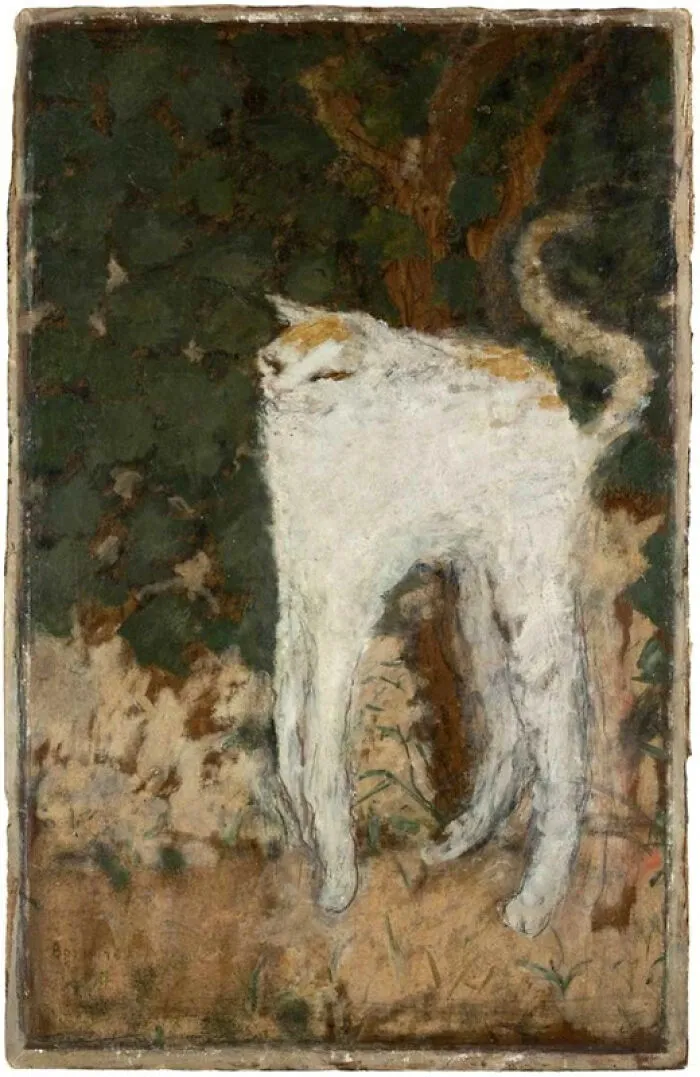
A white cat arches its back so dramatically that it almost looks less like a real animal than a strange creature from a cartoon. Its paws stretch outward, its head sinks between its shoulders, its eyes narrow into slits, and its body forms an exaggerated, almost impossible curve. Pierre Bonnard’s The White Cat, painted in 1894 and now at the Musée d’Orsay in Paris, turns a familiar household animal into something simultaneously comic, elegant, and slightly mischievous.
The painting reveals Bonnard’s interest in Japanese art, particularly the bold, asymmetrical compositions and familiar animals found in Japanese woodblock prints. Artists such as Hokusai and Kuniyoshi had depicted cats in similarly distinctive poses, and Bonnard was an enthusiastic collector of Japanese prints. The flattened background and sinuous lines also place The White Cat within the decorative style of the Nabis, the avant-garde group with which Bonnard was closely associated in the 1890s.
Report
4points
#13 Angry Dog By Edvard Munch, 1938–1943, Munch, Oslo, Norway
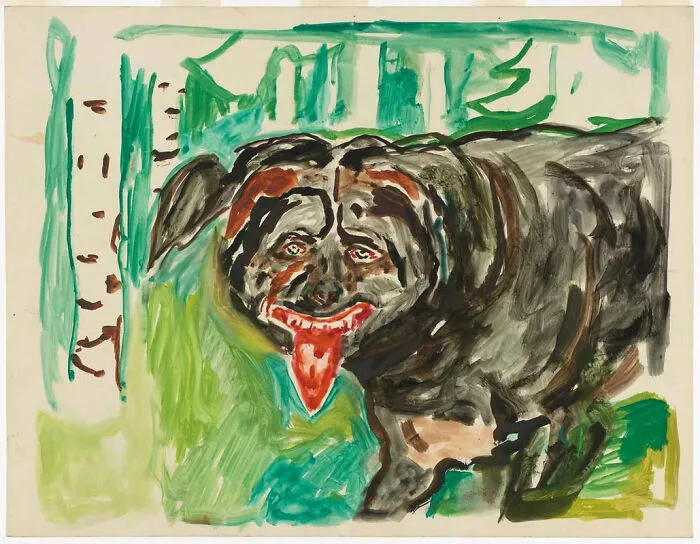
Edvard Munch’s Angry Dog, created between 1938 and 1943, is an unusually humorous late work from an artist better known for anxiety, isolation, and psychological intensity. The watercolor is part of Munch’s extensive group of drawings and prints featuring a dog belonging to his neighbor, Axel Gunnerud. The Munch Museum identifies the animal specifically as “Gunnerud’s dog” and classifies the work as a caricature.
The dog was not simply an amusing artistic subject. Munch had a remarkably contentious relationship with the animal, which he regarded as a serious nuisance and threat. At his home at Ekely outside Oslo, the artist became embroiled in a long-running dispute with his neighbor over the dog, making complaints to the police and filling pages of notes about it. He also produced numerous sketches and caricatures of the animal attacking or confronting people, including postmen, milk boys, children, and household workers. The Munch Museum says Munch wrote more than 100 pages of notes about the dog and repeatedly drew it in exaggerated form.
That personal frustration explains why Angry Dog feels so different from Munch’s more psychologically heavy paintings. He exaggerates the animal until it becomes almost cartoonish: the rigid posture, sharp features, and intense expression turn a neighborhood nuisance into a miniature monster.
Report
4points
#14 The Sphinx By Georg Von Rosen, 1887–1907, Nationalmuseum, Stockholm, Sweden
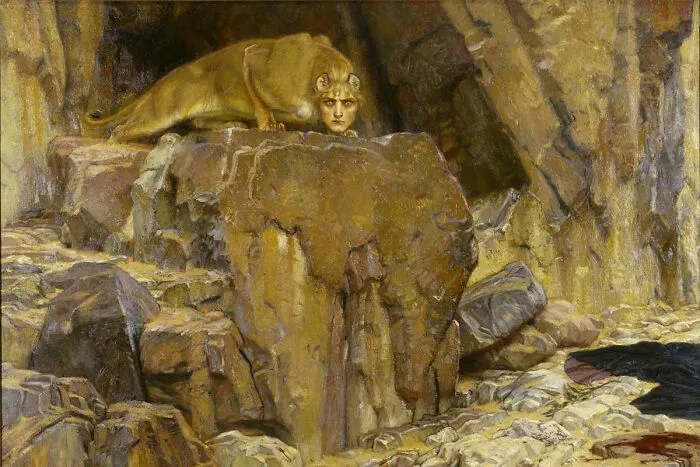
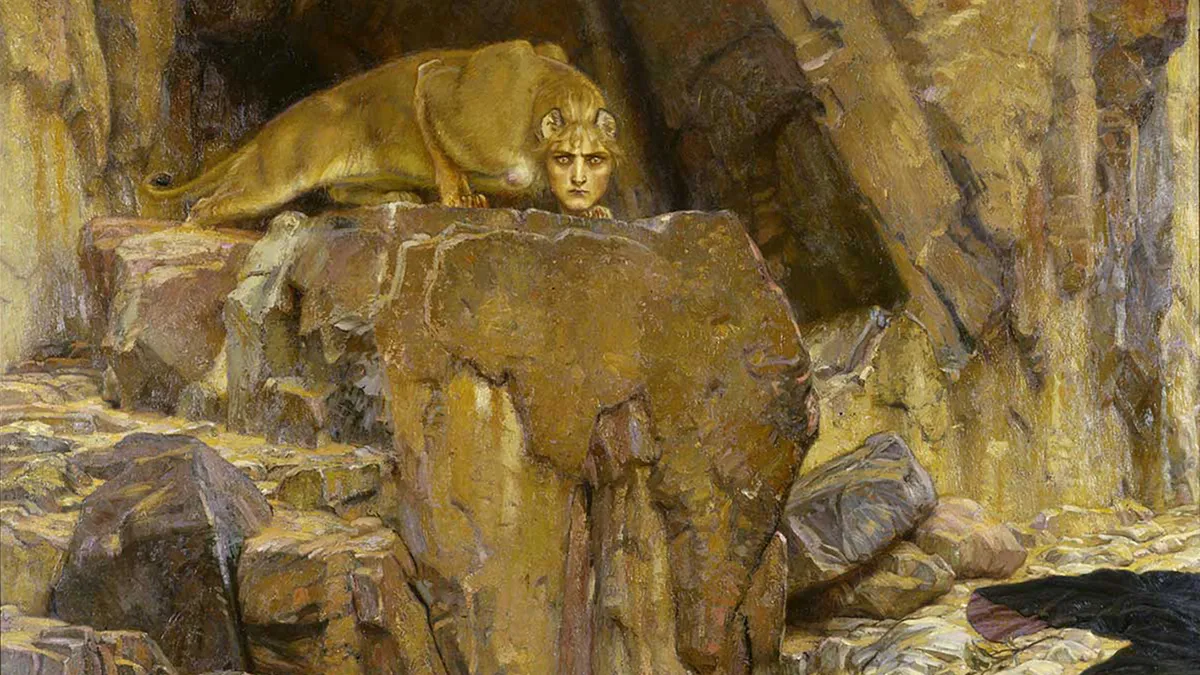
Georg von Rosen’s The Sphinx is a remarkably unsettling interpretation of the ancient myth, painted over a long period between 1887 and 1907 and now in the Nationalmuseum in Stockholm. Rather than showing the famous encounter between Oedipus and the Sphinx, von Rosen gives us the creature itself, silent, watchful, and apparently waiting for its next victim.
The painting is rooted in the Greek myth of the Sphinx, the female-headed creature who challenged travelers with her famous riddle. But von Rosen deliberately expands the meaning beyond the individual story of Oedipus. When the painting was exhibited in 1907, the artist explicitly rejected the popular interpretation that the Sphinx represented a dangerous or destructive woman. Instead, he said that he wanted her to personify “fate, the relentless and inevitable, the terrible, eternally inscrutable riddle of existence.” He even placed the Greek word for “riddle” on the painting.
Von Rosen spent more than twenty years working on The Sphinx, and its enormous scale, about 280 × 365 centimeters, makes the creature feel almost physically present. The painting also caused controversy when it was first exhibited in Stockholm in 1907. Some contemporary viewers interpreted the female sphinx as a symbol of the dangerous power of women over men, but von Rosen's own explanation was considerably more philosophical. For him, the woman was not the monster; the sphinx was an embodiment of the unknowable forces that confront every human being.
Report
4points
#15 The Concert In The Egg By An Anonymous Follower Of Hieronymus Bosch, About 1561, Palais Des Beaux Arts, Lille
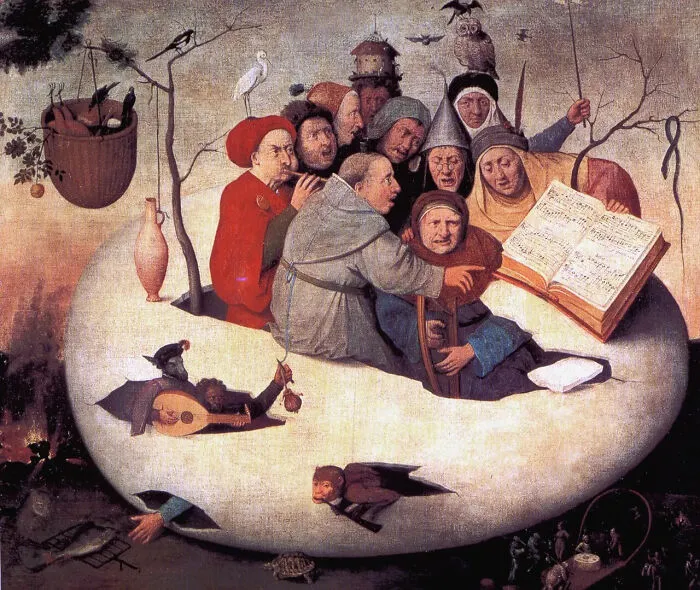
A group of musicians has somehow squeezed itself inside a giant cracked egg, gathering around a shared songbook for an extraordinarily strange concert. There is something almost comical about the scene: singers lean toward the music, instruments emerge from the shell, and a monk points toward the score as though this were the most perfectly ordinary musical performance in the world. But the longer you look, the more unsettling the scene becomes.
The bizarre egg is only the beginning. Inside and around it, musicians sing from a large open book while playing instruments including a lute and a small harp. A figure wearing a funnel-shaped hat appears among them, a detail strongly associated with Bosch's visual language and his fascination with foolishness and human folly. The painting also contains a wonderfully mundane act of deception: one musician is so absorbed in the performance that he apparently fails to notice another figure stealing from him. In other words, the concert may be about music, but the painting is also about how easily people can become distracted from what is happening right in front of them.
Report
3points
#16 Netherlandish Proverbs By Pieter Bruegel The Elder, 1559, Gemaldegalerie, Berlin
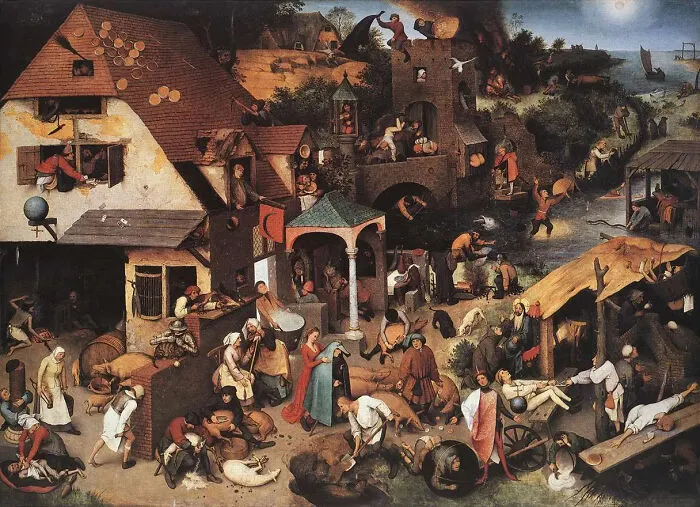
More than 100 proverbs are happening at once in Pieter Bruegel the Elder’s Netherlandish Proverbs, turning an ordinary-looking village into a wonderfully chaotic catalogue of human foolishness. A woman is tying the Devil to a pillow, a man is banging his head against a wall, another is carrying a basket out of a house, and someone is literally throwing roses before pigs. Nothing seems to make sense until you realize that Bruegel has taken familiar Dutch sayings and turned their metaphors into physical actions. Painted in 1559, the work is now housed at the Gemäldegalerie in Berlin.
The painting's original title, The Blue Cloak or The Folly of the World, points toward its larger subject: human foolishness. The villagers are caught in a world where greed, stupidity, hypocrisy, laziness, and self-deception have become ordinary behavior. Even the landscape contributes to the joke. In the background, a globe is shown upside down, reinforcing the idea that this is a world in which everything has been turned the wrong way around. The Berlin museum interprets the scene as a reflection on human folly and sinfulness in a world that has lost its proper order.
Report
3points
#17 The Eye Like A Strange Balloon By Odilon Redon, Lithograph, 1882
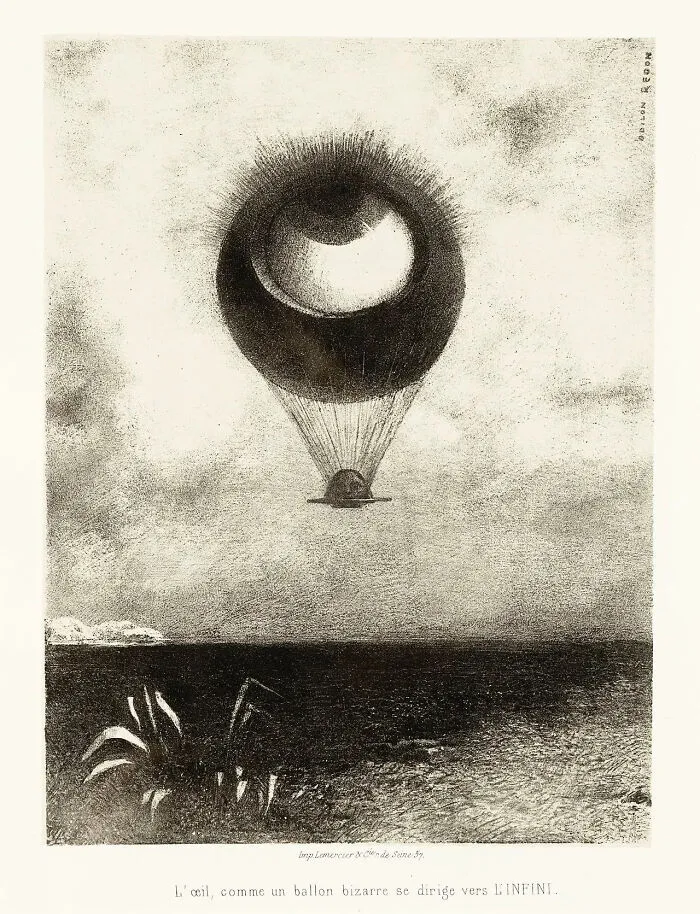
Created as a lithograph in 1882, The Eye Like a Strange Balloon Mounts Toward Infinity belongs to the series Dans le rêve (In the Dream), one of Redon's early explorations of dreams, imagination, and the unsettling territory between the visible world and the mind. The work is now in the collection of the Museum of Modern Art in New York.
Report
3points
#18 The Librarian By Giuseppe Arcimboldo, About 1566, Skokloster Castle, Sweden
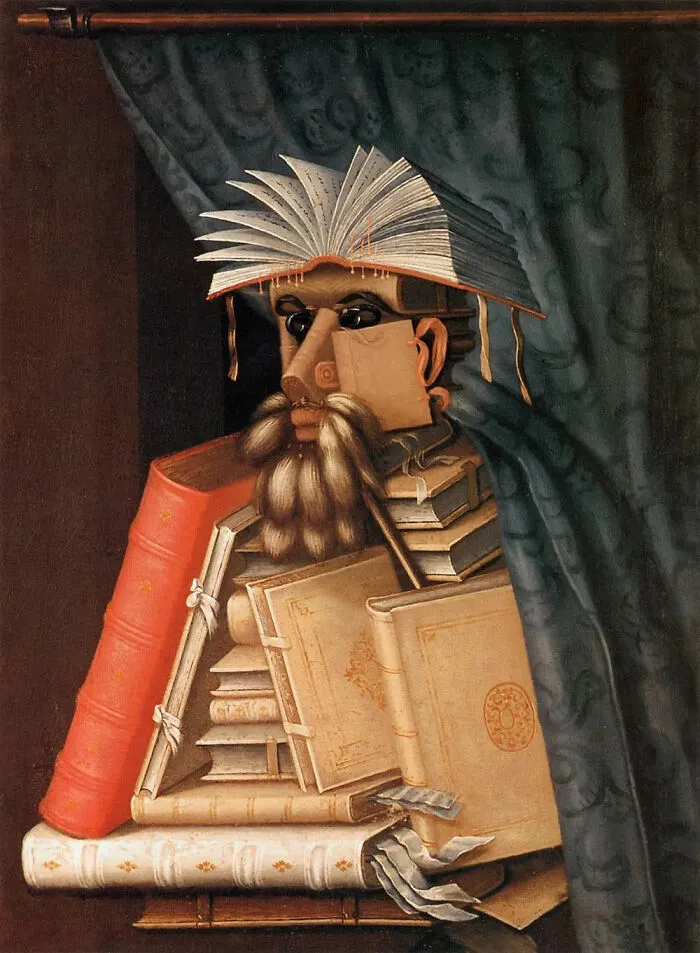
At first glance, it looks like a rather stern Renaissance portrait of a scholar. Look closer, though, and the man begins to fall apart, quite literally. His face, body, arms, hair, and even fingers are made almost entirely from books, bookmarks, and scraps of paper, while a heavy curtain becomes his cloak. Giuseppe Arcimboldo’s The Librarian, painted around 1566 and now at Skokloster Castle in Sweden, is one of the artist’s wonderfully strange “composite portraits,” in which collections of objects are arranged to create a recognizable human figure.
The subject is traditionally thought to be Wolfgang Lazius, a humanist, historian, collector, and scientist who served the Habsburg court and was responsible for the emperor's Kunstkammer, library, and numismatic collection. Every part of the portrait is therefore a visual joke connected to books and scholarship. An open volume on top of the head becomes a hat or hair, bookmarks sticking out from the books form fingers and ears, while the beard is made from what appears to be a feather duster used for cleaning books. Rather than painting a librarian surrounded by his possessions, Arcimboldo turns the possessions themselves into the librarian.
For centuries, the painting has been interpreted as a satire of scholars and librarians, with the absurd pile of books suggesting someone who has become almost indistinguishable from his profession. Art historian K. C. Elhard has proposed a more specific reading: the target may not be scholarship itself, but people who collect books for the sake of owning them rather than reading them. The distinction matters because the painting contains surprisingly few signs of actual intellectual work; instead, the books are treated as physical objects, stacked, displayed, and accumulated.
Report
3points
#19 Un Autre Monde By J. J. Grandville, 1844, Paris, France
A performer juggles entire planets as though they were ordinary balls, while a tiny figure on Earth looks up, apparently waiting for a falling medal. Nothing about the scene obeys the rules of the real world—and that is precisely the point. French artist and caricaturist J. J. Grandville created this extraordinary image for Un Autre Monde (Another World), published in Paris in 1844, a book in which familiar objects, animals, people, and even the cosmos are transformed into a surreal and often satirical alternate reality.
Grandville filled the book with impossible combinations: playing cards come to life, flowers and vegetables take on human personalities, objects develop faces and limbs, and entire worlds become props in elaborate visual jokes. The effect is playful, but there is usually something sharper underneath. Un Autre Monde was not simply an escape into fantasy; Grandville used its bizarre transformations to satirize contemporary society, technology, politics, science, and humanity's fascination with its own progress.
Report
2points