




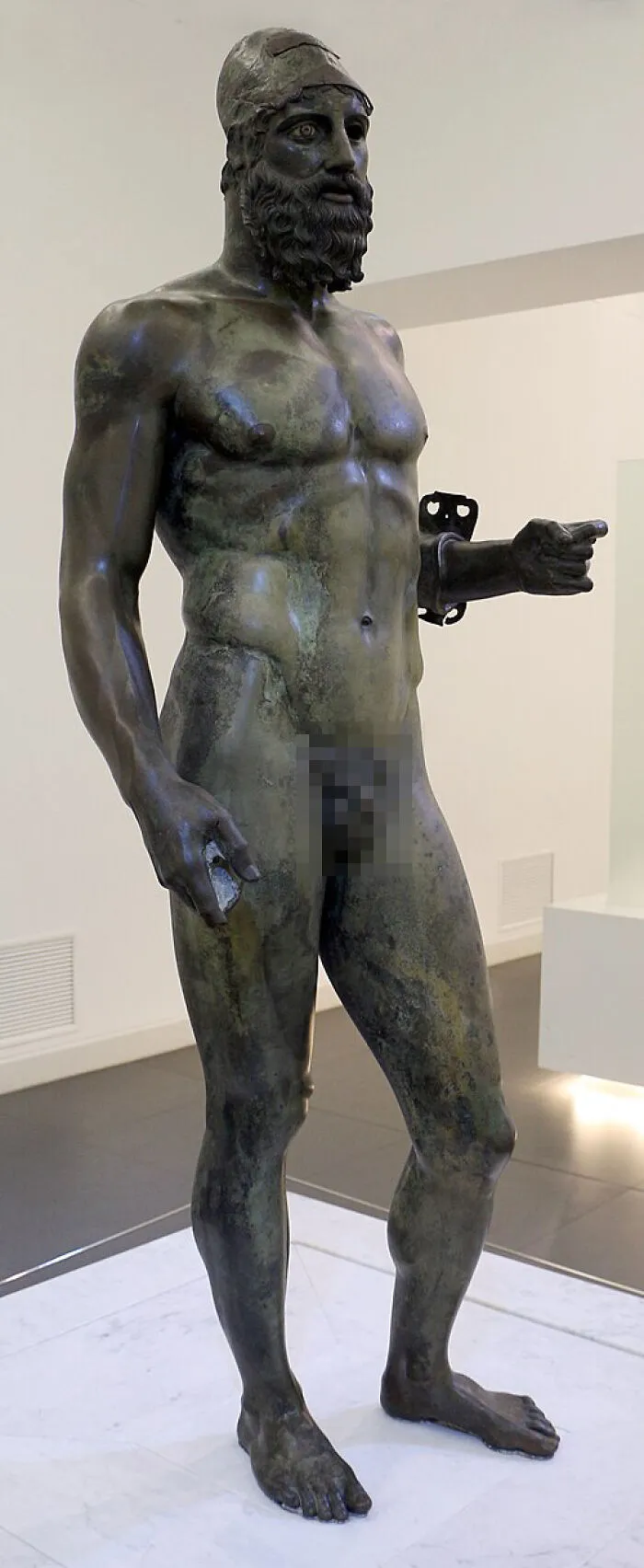
Statue B was originally cast wearing a Corinthian-style helmet pushed back on the head. It shows visible signs of ancient repair. A patched section on the right shoulder suggests Roman-era or later restorers intervened before the statue ever went into the sea. This indicates it was already an old and valued object by the time it was loaded as cargo. Where Statua A reads as youthful and idealized, Statua B has a heavier, more weathered face. Some scholars read the pair as a matched set depicting different life stages of the same heroic type rather than two unrelated commissions.
An accident of transport can obscure profound differences in origin. They surfaced from the same patch of seabed on the same afternoon, which invites treating them as a pair. However, the clay-core analysis makes clear they were made in different cities, probably decades apart, by different hands. They only came together because a Roman collector or looter happened to acquire both for the same shipment. The wreck that carried them has never been located. Archaeologists remain divided on whether the vessel sank in a storm that scattered the statues, or whether it settled intact and still lies buried somewhere nearby.
Almost no life-sized Greek bronzes survive from antiquity because bronze was routinely melted down for coinage or weapons in later centuries. Submersion is the main reason any of the classical bronzes in this feature exist at all. Sinking removed them from that recycling cycle entirely.
Shipwreck: Unidentified, off Marina di Riace
Date cast: c. 460–430 BCE
Recovered: August 16, 1972
Material: Bronze, copper, silver