




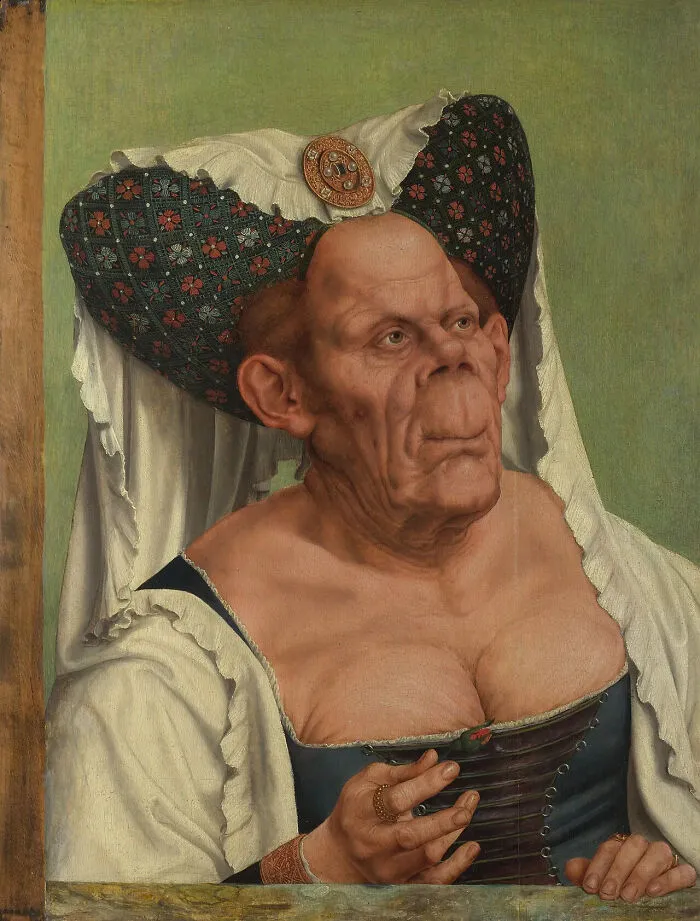
With her enormous forehead, broad nose, prominent chin, wrinkled cleavage, and elaborate horned headdress, the woman in Quentin Massys’ The Ugly Duchess seems almost deliberately designed to challenge every Renaissance ideal of female beauty. And that was largely the point. Painted around 1513, the work is actually titled An Old Woman; “The Ugly Duchess” is a nickname it acquired much later (in the 17th century, the woman was incorrectly identified as Margaret Maultasch, Countess of Tyrol, whose enemies had given her a reputation for exceptional ugliness). Her expensive clothes would already have been decades out of fashion when Massys painted her, while the low-cut, tightly laced bodice was considered particularly inappropriate for an older woman. Rather than presenting a conventional dignified portrait, Massys was creating an early piece of secular satire.
The rosebud in her hand provides an important clue to the joke. The painting originally had a companion portrait, An Old Man, and the woman appears to be offering him the flower as a symbol of love and sensual desire. He, however, raises his hand as though rejecting her advances. Together, the paintings parody the respectable Renaissance marriage portrait: she dresses and behaves as though she were a young woman being courted, while her companion refuses to play along. The National Gallery interprets the pair as a satire on vanity, desire, and the perceived foolishness of people attempting to deny their age.
Renaissance viewers were encouraged to laugh at an older woman refusing to conform to expectations about age, beauty, dress, and sexuality. But the National Gallery's 2023 exhibition devoted to the painting also invited viewers to see her as surprisingly defiant: she looks directly outward, dresses exactly as she pleases, displays her body without embarrassment, and occupies the traditionally more prestigious position reserved for men in paired portraits. More than five centuries later, the woman Massys intended as a figure of satire can therefore look unexpectedly rebellious.
The rosebud in her hand provides an important clue to the joke. The painting originally had a companion portrait, An Old Man, and the woman appears to be offering him the flower as a symbol of love and sensual desire. He, however, raises his hand as though rejecting her advances. Together, the paintings parody the respectable Renaissance marriage portrait: she dresses and behaves as though she were a young woman being courted, while her companion refuses to play along. The National Gallery interprets the pair as a satire on vanity, desire, and the perceived foolishness of people attempting to deny their age.
Renaissance viewers were encouraged to laugh at an older woman refusing to conform to expectations about age, beauty, dress, and sexuality. But the National Gallery's 2023 exhibition devoted to the painting also invited viewers to see her as surprisingly defiant: she looks directly outward, dresses exactly as she pleases, displays her body without embarrassment, and occupies the traditionally more prestigious position reserved for men in paired portraits. More than five centuries later, the woman Massys intended as a figure of satire can therefore look unexpectedly rebellious.