





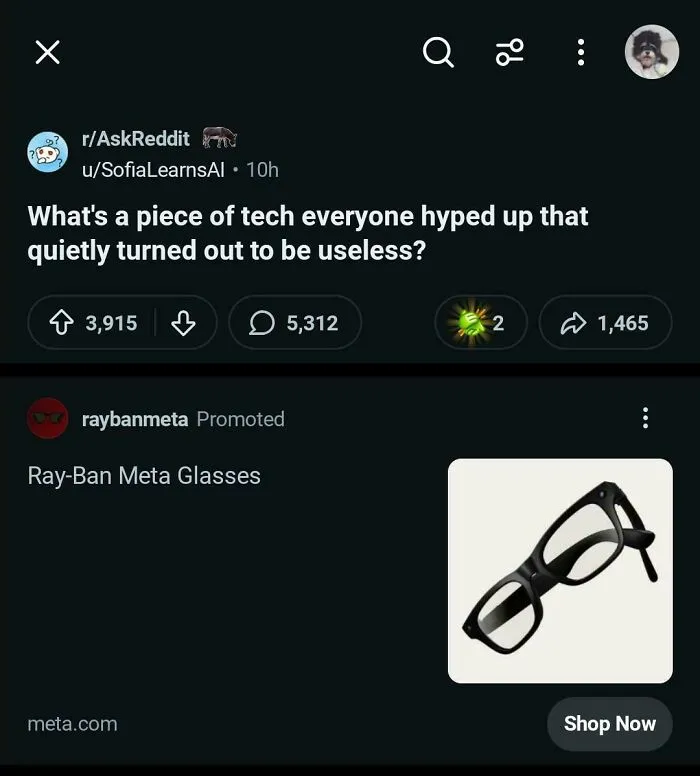


Whether we realize (or like) it or not, advertising has become an ever-present part of our modern lives. From the moment we open our eyes for our morning scroll (admit it, you do it too) till we shut off whatever we’re watching at night, we come across ads in all sorts of places. There’s that pop-up you’ve closed for the bazillionth time, the commercial break in your favorite podcast, the billboard on your way to work, or even the ad carefully disguised as a free recipe in your online grocery shopping haul.



But while these forms of advertising might seem distinctly modern, Alison Hahn, PhD, reminds us that advertisements “can be traced back to the oldest human communities,” with examples found “in Egyptian ruins, in the ashes of Pompeii, and in Mayan cities.” Of course, advertising has become considerably more ubiquitous since then: some estimates suggest that the average American is exposed to thousands of ads every day, with that number increasing considerably over the past few decades.
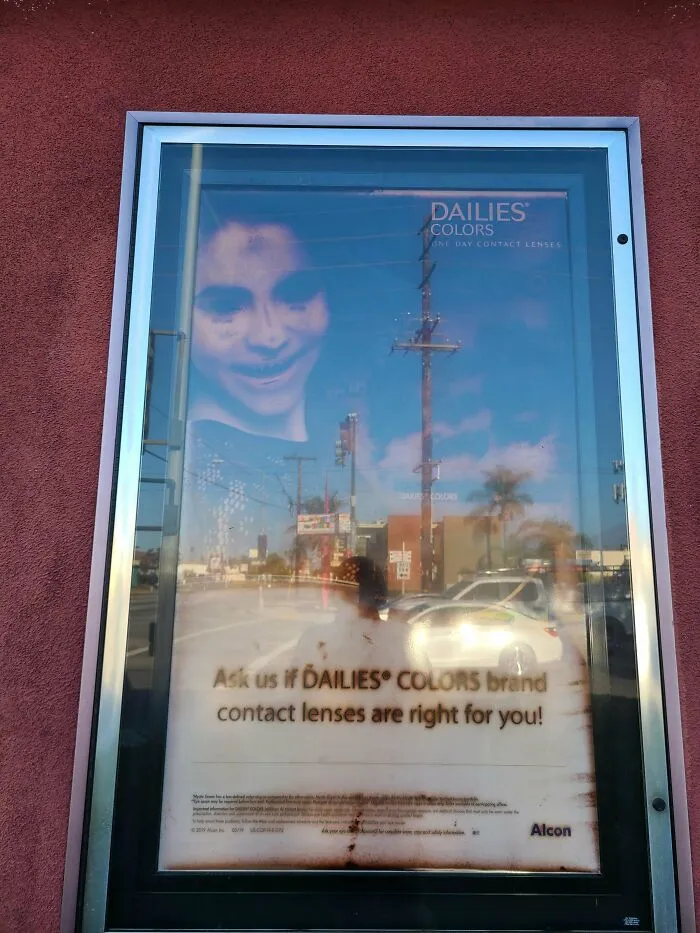
#7 There's An Optometrist Business Near My House That Has This Giant Poster Outside Advertising Colored Contacts. It Seems To Have Aged In A "Is That A Demon?" Way


The reason for making ads has arguably remained pretty constant—to capture our attention and, ultimately, persuade us to buy (or buy into) something—but what’s changed is that the various forms advertising takes have multiplied. Whereas early modern advertisements often took the form of words and images printed on paper, either as part of a newspaper or as advertisements posted in community settings, advertising changed, Hahn explains, “with the development of new printing technologies, as well as other communicative media such as the radio and television, and later the Internet.”


Each new medium has brought with it new possibilities for where, when, and how brands can reach us. Radio and television allowed advertisers to incorporate sound, movement, timing, and programming context into their campaigns, while the Internet—and all that came with it—opened up an entirely new world of possibilities. Suddenly, ads didn’t have to be static messages aimed at a broad audience. They could be tailored to particular groups and delivered directly to people based on their interests and online behavior.

As Derek D. Rucker and Tim Calkins write for the Harvard Business Review, “With new technological advancements happening every day—better customer segmentation abilities, automation tools, new social media platforms—marketers have the opportunity to share their ideas more widely and expand their audiences, perhaps more than ever.”
With all these new opportunities, however, the challenge for marketers now becomes getting people to actually pay attention to what they’re putting in front of them. We’re often described as living in an “attention economy,” and that’s because, as Emilia Kirk writes for Forbes, “Attention is a finite resource.”



We might be exposed to thousands upon thousands of ads each day, Kirk explains, but “The average human brain is simply incapable of processing such a bombardment of content.” That means that we ignore or very quickly forget about the vast majority of ads that we encounter. What this means for advertisers is that they have to find increasingly effective ways to stand out from the noise.

#20 I Followed This Bus For 4 Blocks To Wait For It To Pull Over To Share This Beautiful Work Of Art