





The words "every pregnancy is different" sound like a cliche, but if you say them to someone who is expecting, they will probably nod in approval and appreciate the acknowledgment.
But, of course, there are levels to the phrase, and Dee Michelle (26) together with her partner Antonio Livingston (29) have fallen on the far end of the spectrum.
The couple have experienced what's called a superfetation — a rare case of getting pregnant a second time while you're already pregnant.
Your body makes it nearly impossible for you to become pregnant while a fertilized egg (embryo) is already growing inside your uterus
Image credits: Nataliya Vaitkevich (not the actual image)
But as Dee Michelle's story shows, it can still happen

Image credits: deeandtplusthree

Image credits: deeandtplusthree

Image credits: deeandtplusthree

Image credits: deeandtplusthree

Image credits: deeandtplusthree

Image credits: deeandtplusthree
The mom's TikTok video where she explained her double pregnancy has gone viral
How does superfetation happen?
In humans, a pregnancy occurs when an ovum (egg) gets fertilized by sperm. The fertilized ovum then implants itself in a woman's uterus.
For superfetation to happen, another completely different ovum needs to be fertilized and then implanted separately in the womb. This requires three very unlikely events to take place:
- Ovulation (release of an ovum by an ovary) during an ongoing pregnancy. This is incredibly improbable because hormones released during pregnancy function to prevent further ovulation.
- The second ovum must be fertilized by a sperm cell. This is also unlikely because once a woman is pregnant, the cervix forms a mucus plug that blocks the passage of sperm. This mucus plug is the result of elevations of hormones produced in pregnancy.
- The fertilized egg needs to be implanted in an already pregnant womb. This is difficult because implantation requires the release of certain hormones that wouldn't be released if a woman were already pregnant. There is also the issue of having enough space for another embryo.
The chances of these three unlikely events occurring simultaneously seem virtually impossible.
In fact, superfetation is so rare in humans that there are only about 10 confirmed cases.
Luckily, Dee's family is doing well
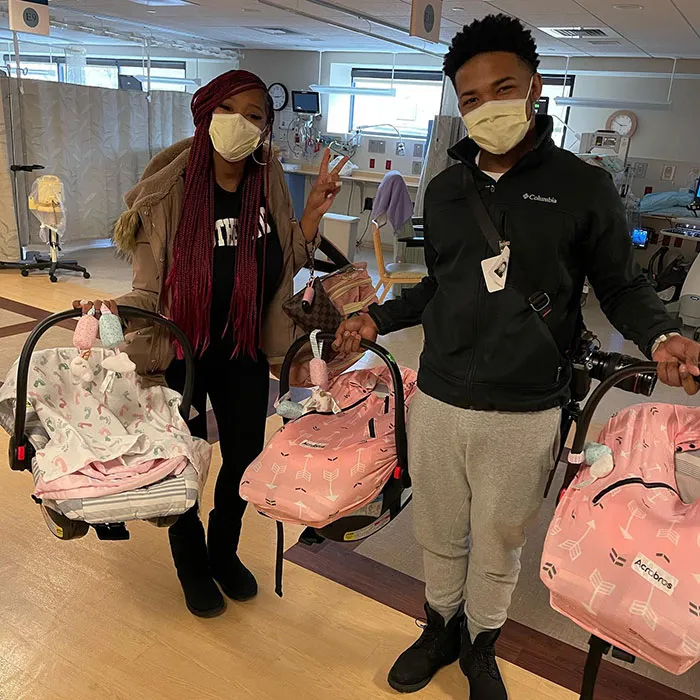
Image credits: deeandtplusthree
While baby C is fraternal and baby A and B are identical twins, Dee explained in another TikTok video that they are basically one unit.
"They act alike," the mom said. "They tend to do all the same things, like they're really triplets. They don't really move as twins and another baby. They move together as triplets, and I love that so, so much."
Dee told BuzzFeed that her pregnancy with triplets took much more care than when she gave birth to one baby.
"It was very intense, with more testing and monitoring needing to be done. I had to change my maternity care appointments to being seen ... bi-weekly for most of my pregnancy. I lived in the hospital for two and a half months after my water unexpectedly broke when I was at 24 weeks. It was exhausting, but also exciting to experience!"
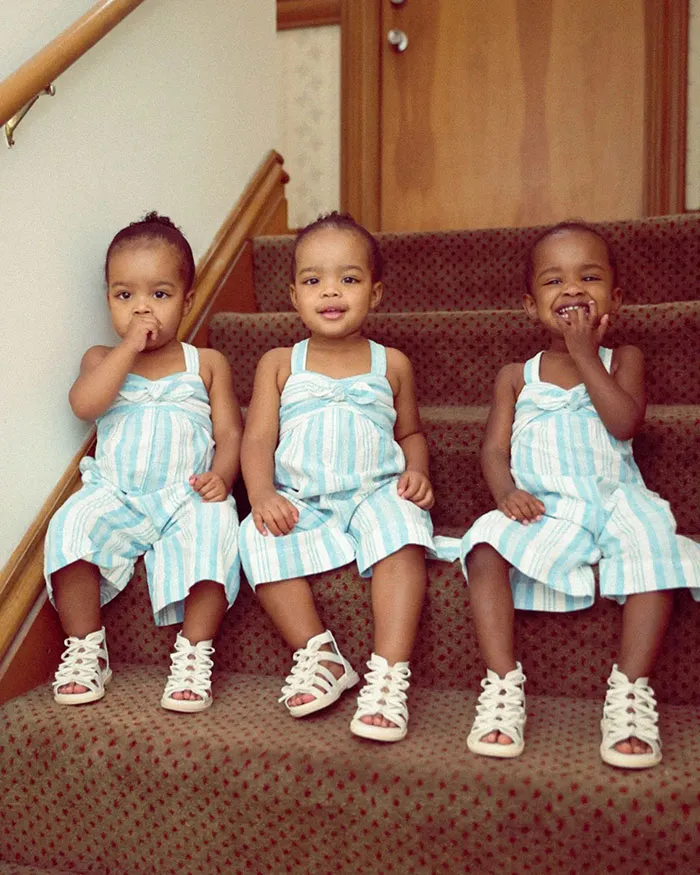
Image credits: deeandplusthree

Image credits: deeandtplusthree
"I probably only went to the hospital four times with one baby, while with my triplet pregnancy I had over 20 appointments," the mom continued.
"Plus, I lived in the hospital on bed rest for a while."
For everyone who is expecting multiples, Dee suggested to "Enjoy the moment, don't be scared, stock up on diapers and wipes (we changed 24 a day in the beginning), and create a good plan."
"I know things don't always go as planned with pregnancies, but planning ahead solves a lot of issues."

Image credits: deeandtplusthree
Dee said that ultimately, she shared her story to inspire and help other mothers: "I want women to know that anything is possible, no matter what odds may be against them"
Image credits: MART PRODUCTION (not the actual image)
Many people had no idea this was even possible