



#1

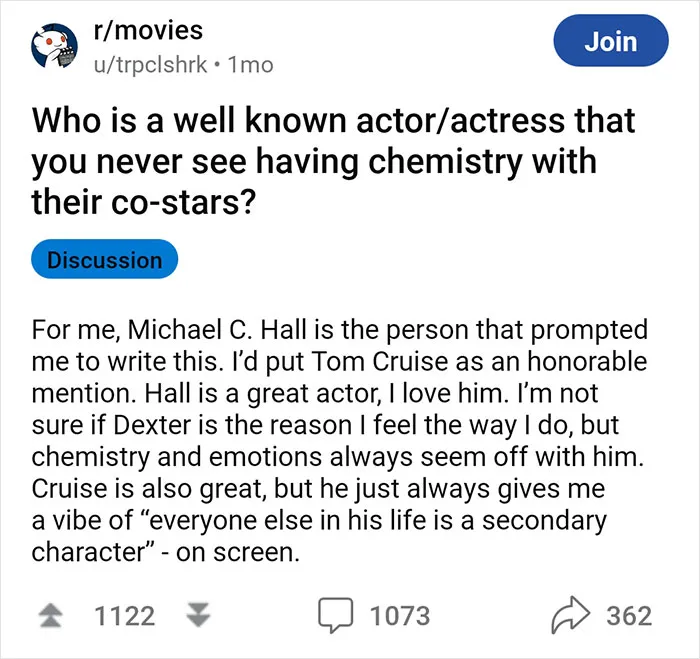
Reddit user u/trpclshrk opened up to Bored Panda that what inspired them to create their thread in the first place was having seen a post asking about actors with the best on-screen chemistry.
“For some reason, I thought about how Michael C. Hall, even playing Dexter, came across as genuinely not very humanly relatable to me. I’ve seen him in a few other things, but not his other biggest role, which many folks pointed out as disproving my feelings about him,” the OP told us.
“Tom Cruise also came to mind, only because he gives off such a ‘main character’ vibe. Real-life self-absorbed people seem this way sometimes. They may be very likable and fun, but it always feels like their circle of people is just an audience that could easily be interchangeable,” the author shared their thoughts.
#2

#3

The OP told Bored Panda that they were pleasantly surprised by the reaction that their thread got, especially since they asked the question out of genuine curiosity, not to go viral. The redditor said that they saw a lot of internet users defending Hall and his acting.
However, despite the criticism, u/trpclshrk pointed out that they still respect both Hall and Cruise for their skills. “I don’t think either one is a bad actor at all. Please don’t take it that way. I love both,” they said.
Something that the OP noted is the actors who “seem warm or have chemistry were those that had sad-ish eyes.” They added that they realize this sounds a little bit out there. “But Bradley Cooper, Mads Mikkelsen, Al Pacino, they always feel like they really mean things in movies to me,” they said.
“Cooper is a great example of looks and often portrays a beautiful douche kinda, but also always seems to have a heart of gold deep down. I think it’s the eyes.”
#4

#5


In the meantime, Bored Panda reached out to Mike Sington, Hollywood’s Ultimate Insider, to get his thoughts on sparking chemistry between actors if it’s been lacking initially. He told us that chemistry between co-stars can really enhance the quality of their performance. However, Sington stressed the fact that chemistry can’t always be forced. It takes time, effort, and a willingness to collaborate in order for that to happen.
His first tip is to spend more time together, as well as rehearse together. “Building a rapport off-screen through socializing and getting to know each other can help create a more comfortable on-screen dynamic,” he explained why this is so important.
Meanwhile, stars can develop a more natural flow and connection if they practice their scenes together and work on their dialogue delivery, as well as their timing. The better the actors understand each other’s characters, motivations, and backstory, the better they can interact in scenes.
It can really help if all the actors embrace their characters’ relationships as they are, fully immersing themselves in their roles. That way, their chemistry can evolve organically, rather than in a forced way.
#7

#8


A big part of building chemistry comes down to developing trust. Ideally, actors should trust their co-stars to the point that they allow themselves to be vulnerable and take creative risks during the scenes they’re in. “Share your thoughts and ideas with your co-star, and be receptive to their feedback,” Sington told Bored Panda about the importance of open communication.
Once they’re comfortable around one another, they can start experimenting with different acting techniques. “Try various acting exercises, improvisation, or methods to explore different ways to connect with your co-star,” the entertainment expert suggested.
Bored Panda also wanted to get the expert’s thoughts on how actors can deal with coworkers who have difficult, challenging personalities. After all, working alongside them can be very challenging. According to Sington, it’s extremely important to maintain professionalism at all times.
“Focus on your own work and maintain a professional demeanor. Avoid getting involved in any conflicts or drama,” he urged actors. “Concentrate on your acting and the project at hand, as the quality of your work is ultimately what matters most.”


#12

Coworkers who don’t get along can try to be more empathetic toward one another and look for common ground. “Look for shared interests or goals that can help build rapport and make the working relationship smoother,” Sington advised. “Try to understand where your colleague is coming from and what might be causing their difficult behavior. This can help you approach the situation with more patience.”
Actors should also be willing to talk to their colleagues about any concerns that they have. But it’s essential that these discussions are respectful and constructive, not accusatory. In the meantime, they can work on establishing some clear boundaries and seeking the support of the director, producers, or managers, if things get really difficult.

#14

Chemistry—or a total lack of it—is something that the audience instinctively notices, whether they watch the movie at their local cinema or at home. You can clearly see when the actors ooze charisma, ease into their roles, and instinctively play off one another. It’s also very easy to see when there’s virtually no rapport between the actors and their dialogue and behavior is stiff, clumsy, and awkward.
Sure, some high-level editing can help mask a lack of chemistry between the actors, but it only serves as a very last-minute band-aid. The real problems run far deeper than that. These issues should have been addressed by the director, the producers, and the stars themselves on-set, not during the post-production process.
Of course, telling someone to fix the chemistry on the set is far easier said than done. You won’t magically make celebrities vibe just by asking them to. Chemistry takes time and trust to develop. The more time a person spends around their colleagues, the more they get to know them. That way, they become more familiar with their style of work and thinking and can anticipate how they’ll act.

#17

#18

Simply put, unless you’re dealing with acting geniuses or the most seasoned professionals with decades of experience, you probably won’t see instant chemistry between them and the other actors. That’s why it’s so important that everyone’s open to taking direction well. The director and the rest of the crew can give the actors some pointers and help break the ice. Meanwhile, some teambuilding activities and time spent together after work can help the stars vibe with one another more.
However, this highlights two other issues. Namely, the importance of respect and being able to take criticism well. Respect is absolutely fundamental when it comes to healthy group dynamics, whether at work or elsewhere. If you do not see your coworkers as someone worthy of your time, effort, and attention, your results won’t be as good. Workplace leaders know that supporting their colleagues is essential because it brings out the best in them. On the flip side, very few people can tolerate arrogant coworkers who look down on them.
#19